What are the Warriors' options as Kristaps Porzingis remains away from the team?
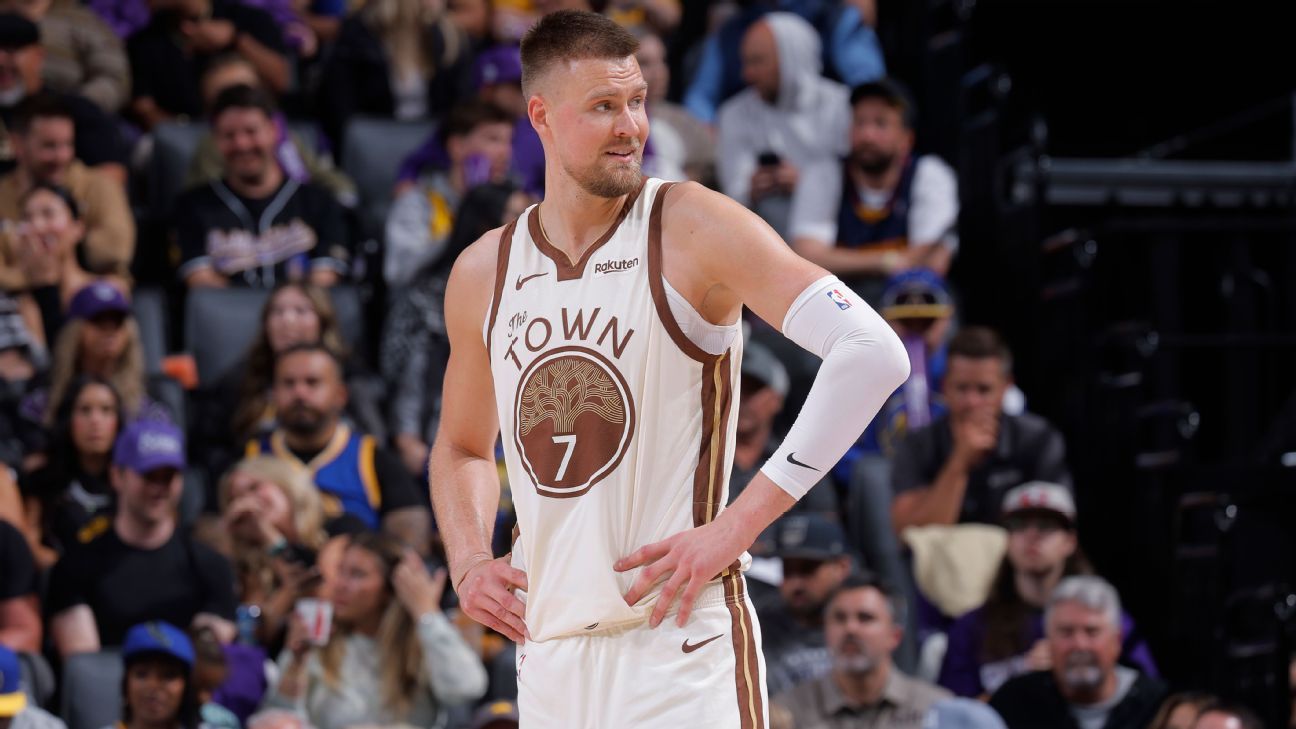
ON OPENING NIGHT of his 15th NBA season, Draymond Green -- generously listed at 6-foot-6 -- was slotted as the Golden State Warriors' starting center despite a continued organizational understanding about the accumulated toll it takes on his 36-year-old body.
The Warriors' staff gave Green a physical reprieve two nights later against the Memphis Grizzlies' jumbo front line. But circumstances, which include Al Horford's inability to play bigger minutes in his 20th season, forced Golden State to start Graham Ike, a two-way undrafted center out of Gonzaga in his second career game.
That still left Green out there in the late deciding moments attempting to box out the 7-4 Zach Edey. After failing to wall him off on a defensive rebound, Green committed a crucial frustration foul while the Warriors blew a 12-point lead and fell to 0-2 for the first time since 2020-21.
"We got what we got," Green said when asked about the eroded state of the Warriors' center position. "So we got to make it do what it do."
The Warriors feel part of the reason for their 37-45 failure a season ago was a woe-is-me attitude about the schedule and injury misfortune, team sources said, so they have taken a purposeful no-excuse approach this regular season.
That has meant an out-of-sight, out-of-mind strategy when it comes to the ongoing absence of presumed starting center Kristaps Porzingis, who was re-signed this summer despite missing 90 games over the past two seasons with three different teams. Ever since Porzingis called out of work one day prior to training camp, the front office instructed Steve Kerr to strategize and prep his team as if Porzingis was a nonfactor.
General manager Mike Dunleavy and lead medical decision maker Rick Celebrini are the only members of the team's staff who've been in communication with Porzingis during his absence. Kerr has bristled at nearly every Porzingis question in recent weeks.
"I don't know," Kerr said when asked for a recent update. "I don't really have anything else to add on this."
The decision to make a $20 million bet on the now-invisible Porzingis this offseason looms large over their 1-3 start and their murky path forward. On opening night, the same day ESPN reported the Warriors were beginning to explore possible trade routes while Porzingis contemplates his basketball future, opposing center Walker Kessler dunked on them 10 times, the most in a game for a Los Angeles Lakers center since Shaquille O'Neal in 2003.
In the aftermath, the always diplomatic Stephen Curry was asked about the unfortunate nature of Porzingis' indefinite absence and the impact it is having on his team.
"Aggggh," Curry said, tapping on the table as his frustration seeped through. "It's a hard one for all reasons."
Curry twice made sure to mention the human component, expressing sympathy for Porzingis, who has made public the lingering impact he said he still feels after contracting an upper respiratory viral illness while with the Boston Celtics two seasons ago.
"We always said availability was a big factor for our team with all the guys we have out," Curry said. "It's no secret that the [center] spot is an important one for us, especially with his skill set. It's hard to talk about without keeping the humanity of it in mind. But it is a tough one to figure out."
Team sources continue to express an extreme level of pessimism that Porzingis will ever play for the Warriors again, but he could end up helping the organization in another way, because his contract, which is only guaranteed for $3 million next season, could still prove to be valuable in executing a trade.
Here is everything we know as the situation remains in limbo.
How did Porzingis and the Warriors get here?
Porzingis' current salary slot was actually created during the summer of 2025, during one of the strangest restricted free agency standoffs in recent memory. Dunleavy and the Warriors were uneasy about committing long-term to Jonathan Kuminga, but felt he still held more value and upside than the sign-and-trade offers on the table.
So they stood firm in negotiations and eventually compromised with Kuminga on a two-year, $46.8 million deal that included a team option and a requirement that Kuminga waive his implicit no-trade clause. They were hopeful he'd contribute but made their motives clear enough during negotiations that Kuminga's side felt he was being turned into a human trade exception.
The Warriors flipped his contract to Atlanta for Porzingis' expiring $30.7 million contract in February, maintaining salary flexibility while believing they could manage Porzingis' health well enough to get some production out of him.
It worked decently. Porzingis appeared in 15 of the team's last 20 games and averaged 16.1 points, 5.3 rebounds and 1.1 blocks. That gave the front office and medical staff enough confidence to greenlight a two-year, $40 million extension in late June for a player who expressed a desire to continue his NBA career.
Still, the Warriors built in protections for a move they knew carried major risk by only guaranteeing $3 million of the $20 million in the second season. They also structured the extension so Porzingis could be traded immediately instead of having to wait until Dec. 15.
But Dunleavy and the Warriors held belief that Porzingis would be an available rotation piece for chunks of the schedule, not just a tradable contract. There was pre-camp buzz from the coaching staff about the intriguing nature of a Yaxel Lendeborg, Green, Porzingis front line.
Porzingis was in the practice facility getting court work the week prior to training camp and attended Jimmy Butler's player-led event in San Diego in late September. But optimism faded as team sources in attendance described Porzingis as indifferent and uninterested in participating in scrimmages and strenuous on-court prep work at the event -- a blaring signal of what was on the horizon.
What are the Warriors' options with Porzingis?
Porzingis called Dunleavy and stepped away from the team on the eve of training camp to deal with what they deemed a private health matter. The Warriors gave him some space initially but expected him to return to the facility and be around his teammates and the medical staff, team sources said.
After a meeting with Celebrini and Dunleavy in early October, the team sent out a statement declaring he would be around. It didn't last. Porzingis hasn't returned to the facility and the organization shifted his official status from out with "general illness" (as they'd listed during his absences last season) to "not with team," a purposeful change. This can no longer be described as an excused absence for the center.
Porzingis' unwillingness to be present at the Warriors' facility could be deemed a failure to render his services -- a reality that has been raised internally, sources said -- and could be used in an attempt to void his entire contract. But that would present its own complications, unless Porzingis expressed an intention to retire and willingly gave all the money back.
The Warriors are currently $20.4 million into the luxury tax. Wiping away Porzingis' salary erases nearly all of their tax bill, ducks them under the first apron and gives them more trade flexibility, but it doesn't free up a major roster-building tool. They'd only be able to add a player on the minimum via free agency.
The Warriors had a similar situation two seasons ago. They signed De'Anthony Melton to a one-year, $12.8 million deal in July 2024. He tore an ACL in early November and was ruled out for the season.
In response, Dunleavy lined up a trade with the Brooklyn Nets for Dennis Schroder, set to be executed on the first day Schroder was eligible to be traded (Dec. 15). It cost them a net of two second-round picks. Schroder played 24 games with the Warriors before he was traded as part of a deadline deal to acquire Butler.
That'd profile as a preferred route for the Warriors in this current Porzingis jam -- utilizing a minor asset to acquire a usable rotation player in the interim while maintaining the flexibility to repackage that expiring number for a larger swing at the deadline.
But under the new anti-tanking rules, there aren't any obvious trade partners ready to part with a usable player for a minor asset, especially in late October. Dunleavy has already gauged the temperature on the trade market, league sources said, but this is traditionally a quiet time in that respect. Front offices are typically in fact-gathering mode about their roster before making bigger-picture decisions closer to January and February.
Right now, the Warriors are showing a willingness to remain patient with the Porzingis contract and let the market materialize, league sources said. If Porzingis proves willing to give back a large chunk of money in a buyout, his expiring $20 million deal could become even more financially appealing for an eventual trade partner attempting to gain some financial benefit.
What is the Warriors' plan in the interim?
Lendeborg's immediate success has brightened the mood and eased some concern around the Warriors. The rookie wing had 31 points, 12 rebounds and six assists in a surprising blowout win in Denver on Monday night.
Lendeborg's power and size (6-foot-10, 241 pounds) has allowed them to downsize with Green at center while feeling bigger than their previous small-ball lineups. Lendeborg has 37 rebounds in four games.
Their current starting lineup (Lendeborg, Green, Curry, Brandin Podziemski and Gui Santos) is a plus-22 in a small early season sample. Horford -- limited to around 20 minutes per game and unable to play back-to-backs -- has looked fresh in brief doses.
While evolving through a semi-rebuild, the Warriors have shown an increased willingness to give opportunity to their youth in an effort to unearth some gems and improve their long-term outlook.
Ike has started two of the first four games, but will be limited to 50 games total unless the Warriors can convert his two-way contract to a full deal. Charles Bassey, the 25-year-old journeyman who is attempting to catch on with the Warriors after five previous stops, provides another big body off the bench.
"I love the attitude of this team," Kerr said. "I love the energy, the spirit. I like our talent. Then I think our two young big guys are good players."